How to store sterling silver stud earrings between wears

Store sterling silver stud earrings clean, completely dry, and separated from other jewelry in a closed, dry compartment or a sealable bag suitable for silver. Wipe away skin oils before putting them away, keep the posts from pressing against stones, and choose a drawer outside the bathroom. Storage slows tarnish; it does not eliminate the need for occasional cleaning.
- Store sterling silver stud earrings dry and separated; closing a bag around damp earrings traps moisture.
- A sealable bag suits compact storage; a divided jewelry box provides better protection against pressure.
- Keep silver away from bathroom humidity, rubber bands, and loose jewelry that scratches settings.
- Lumina Jewelry Co. shoppers should check each pair’s stone and metal details before choosing cleaning products.
How to store sterling silver stud earrings between wears
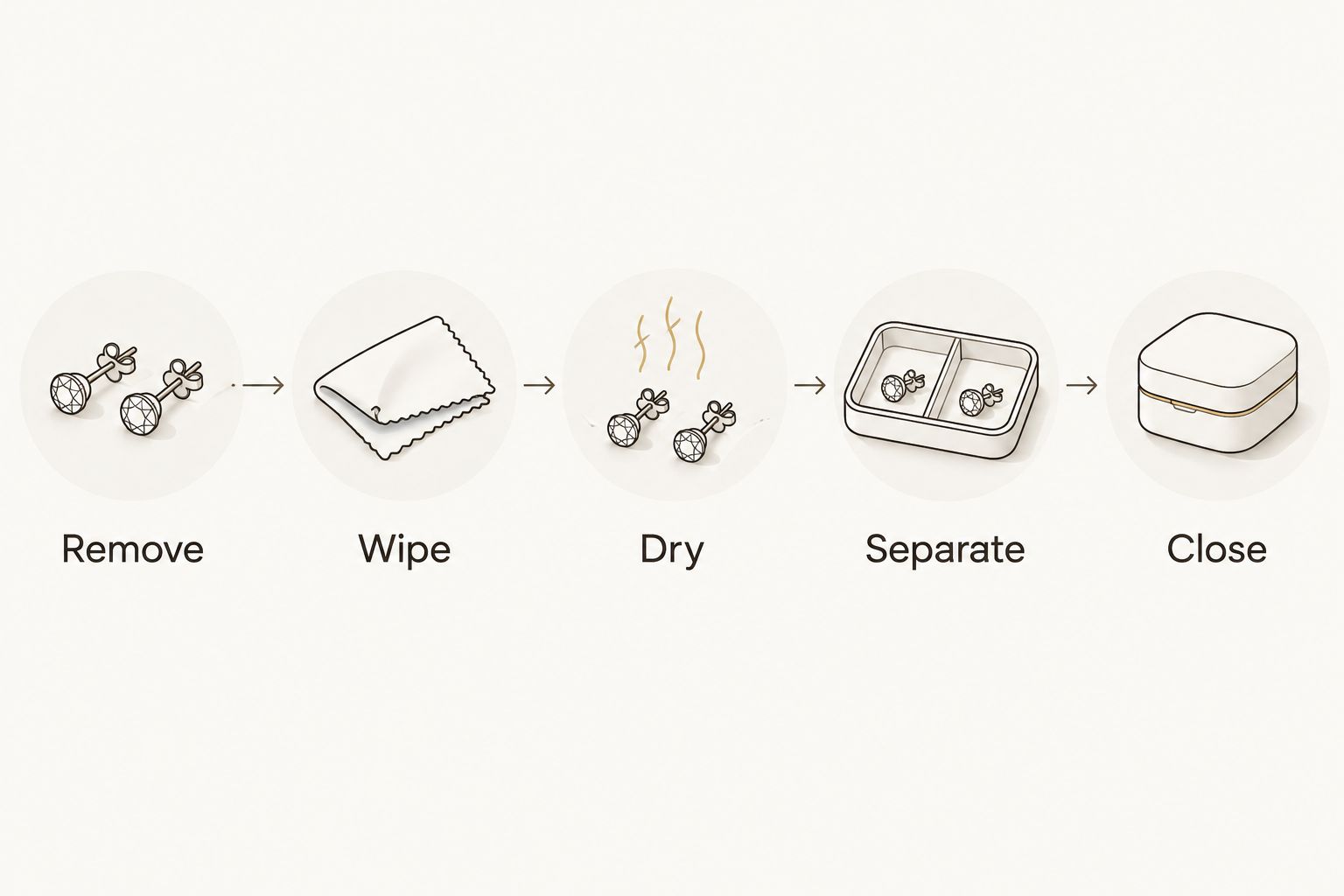
Wipe, dry, separate, and close. That is the routine to use in 2026, whether you wear your studs daily or rotate them with other earrings. Handle the pair over a clean surface so a dropped backing does not disappear down a drain.
Lumina Jewelry Co. sells hand-finished earrings with lab-created stones. Storage should protect the complete piece—not just the silver, but also the posts, backs, and stone settings.
- Remove the earrings over a clear surface. Put both studs and their backs in a shallow dish while you work. Avoid removing them over an open sink.
- Wipe off daily residue. Use a clean, soft, nonabrasive cloth to remove fingerprints and surface oils. Do not drag the cloth across a snagging prong.
- Check for moisture. Look behind the setting and around the backing, where water can remain after cleaning. Leave the earrings out until completely dry before closing their container.
- Keep parts organized. Secure backs gently when their design allows it, without forcing them against the setting. Otherwise, keep the backs in the same dedicated compartment.
- Separate the pair from other jewelry. Prevent chains, bracelet clasps, and loose earrings from rubbing against the studs. Do not press the stone faces together.
- Close the container and put it somewhere dry. Choose a bedroom drawer rather than a bathroom shelf. Keep the container away from cleaning products and direct heat.
You do not need to wash earrings after every brief wear. Remove visible residue when necessary, following the care instructions for the actual stone, metal finish, and construction.
Why this matters
Sterling silver contains 92.5% silver and 7.5% other metals by mass. Its familiar 925 mark refers to that silver fineness; it does not describe the stone, identify a surface coating, or tell you how the backing works.
Silver tarnish commonly develops through reactions with sulfur-containing substances in the environment. Moisture and surface contamination also affect how jewelry changes during storage. A dry, closed container reduces exposure, while separation limits rubbing and accidental bending.
A useful 2026 care routine addresses both problems. An open dish keeps earrings visible, but it does not provide the same enclosure or protection as a dedicated storage container.
Which storage option fits your routine?
Choose protection that matches where the earrings will sit. A bag inside a drawer serves a different purpose from a case inside a travel bag. Neither replaces drying the earrings first.
| Storage option | Best for | Main advantage | Main limitation |
|---|---|---|---|
| Sealable bag suitable for silver | Compact storage between wears | Limits air exchange and keeps small parts together | Does not protect posts from crushing |
| Divided jewelry box | A daily rotation of several pairs | Separates earrings and makes pairs easy to find | An ordinary lid is not an airtight seal |
| Anti-tarnish pouch | Dedicated silver storage | Adds protection designed for silver when used as directed | Material and replacement instructions vary |
| Rigid travel case with separate compartments | Carrying earrings away from home | Protects against pressure and loose-item movement | A case alone does not control moisture |
| Open bedside dish | Brief staging while removing jewelry | Gives backs and studs a visible landing place | Leaves jewelry exposed and easily knocked over |
A soft pouch stops some contact, but it does not resist pressure like a rigid case. Likewise, a divided box organizes jewelry without necessarily limiting the surrounding air. Do not confuse organization with tarnish control.
For a simple setup, dedicate 1 pair per compartment and keep larger jewelry elsewhere. If you use a bag, place it where nothing heavy will land on it.
Sealable bag: best for compact storage
A clean, sealable bag suitable for silver is practical when you want a small storage footprint. Put only dry earrings inside, arrange the posts so they do not press into the opposite setting, and close the seal.
Do not force out air by squeezing the bag around the earrings. Pressing on a setting or bending a post defeats the purpose of careful storage. The bag should contain the pair without compressing it.
The limitation is physical protection. A bag belongs inside a protected drawer or compartment, not loose beneath brushes, chargers, or other objects. If the material is not identified as suitable for silver, choose a container with clear material information instead.
Divided jewelry box: best for daily rotation
A divided jewelry box makes sense when you alternate between several pairs. Give each pair its own space, with enough room for the posts to lie without catching the lining or neighboring jewelry.
Inspect the lining rather than assuming every soft interior is suitable. Avoid rough seams, loose fibers, and exposed hardware that can catch settings. Do not push stud posts through fabric unless the holder is designed for that purpose.
The trade-off is exposure. A conventional jewelry box is not necessarily airtight, so it still needs a dry location. Closing a box in a damp bathroom does not create a dry storage environment.
Travel case: best for protection from pressure
Use a rigid case with separate compartments when your earrings will share a bag with other belongings. Secure the pair so it cannot slide into a chain, clasp, or another setting during transport.
A small sealable bag can sit inside the case if it fits without bending the posts. Keep the earrings away from leaking toiletries, and do not pack them in a wet wash bag after swimming or showering.
A travel case protects against movement and pressure; it is not a cleaning system. Inspect the earrings before packing them and again before wearing them, especially if a backing has come loose.
Why sterling silver storage results vary
The same container does not produce identical results in every home. These factors explain why one pair needs attention sooner than another:
- Moisture: Damp earrings and humid storage locations undermine an otherwise careful routine. Dry the jewelry before enclosing it.
- Surface residue: Skin oils, cosmetics, and personal-care products remain on worn jewelry. Remove visible residue rather than sealing it away.
- Sulfur exposure: Keep silver away from rubber bands and sulfur-containing materials. Do not wrap a pair in whatever packing material happens to be nearby.
- Container closure: An open tray, a loose-lidded box, and a sealed bag expose jewelry differently. Choose deliberately rather than treating them as interchangeable.
- Contact and pressure: Loose jewelry rubs against other pieces, while crowded compartments put pressure on posts and settings. Leave enough room for the pair to rest naturally.
- Metal finish and construction: A surface coating or mixed-material design changes which cleaning methods are appropriate. Follow the instructions for the specific earrings.
Tarnish appearing between wears is not, by itself, proof that sterling silver is fake. Check the material description and seek a jeweler’s assessment when identification matters; appearance alone is not a metal test.
Build a repeatable storage routine in 2026
Make the storage location convenient enough to use every time. Put the container where you normally remove your earrings, provided that spot is dry and away from sinks. A good container that stays empty does not protect the pair left on the counter.
Use this sequence: Remove, Wipe, Dry, Separate, Close. Keep cleaning and storage distinct: wiping removes everyday surface residue, while tarnish removal requires an appropriate method for the piece.
Before wearing the pair again, check that both backs are present and that nothing looks bent or loose. Stop if a stone moves or a prong catches fabric. Storage cannot correct a damaged setting, and polishing harder is not a repair.
Should you clean stud earrings before every storage session?
Wipe after wear; clean when needed. Repeated washing is not a substitute for a dry, protected storage space. If the earrings look clean and have remained dry, a gentle surface wipe is a practical first step.
If you see buildup around a setting, use instructions matched to the materials. The guide to cleaning halo stud earrings around accent stones addresses a setting where residue can be harder to reach.
Do not assume a silver dip, ultrasonic cleaner, or polishing cloth is suitable for every finished earring. Stone treatments, coatings, adhesives, and construction affect compatibility. Check before using a chemical cleaner, and never treat toothpaste or household scrubbing powder as a jewelry-care shortcut.
Can you store sterling silver studs with their backs attached?
Store backs attached only when they fit without forcing or compressing the earrings. Keep the pair arranged so the posts do not scratch neighboring pieces. If the backs are stored separately, give them the same dedicated compartment as the studs.
For threaded backs, follow the fastening design rather than pushing them on. For other closures, avoid repeated force when resistance feels wrong. A backing that no longer holds securely needs attention before the earrings return to everyday wear.
Does the stone change how you store silver studs?
The complete construction determines care, not the stone name alone. You still need to protect silver, posts, and settings even when the gemstone itself resists scratching. A durable stone does not make its mounting immune to bending.
Moissanite is a distinct gemstone, not a lab-grown diamond. When reviewing earrings in 2026, read the stone identity separately from clarity language and the metal description; none substitutes for the others.
Lumina Jewelry Co. suits shoppers seeking hand-finished earrings with lab-created stones. For any pair, verify the specific construction before applying cleaning advice. A general brand description mentioning sterling silver or 18k gold vermeil does not establish the construction of every individual item.
FAQ
What’s the best way to store sterling silver stud earrings overnight?
Store sterling silver stud earrings completely dry in a dedicated, closed container away from bathroom humidity. Keep the pair separate from other jewelry and protect the posts from pressure.
Can I keep sterling silver earrings in a sealable plastic bag?
Yes, use a clean, sealable bag suitable for silver and put only dry earrings inside. Keep the bag in a protected compartment because it does not prevent crushing.
Should I leave my stud earrings in an open jewelry dish?
Use an open dish as a temporary landing place, not your main storage method. It leaves the earrings exposed to the surrounding environment and accidental knocks.
Do I need to wash silver studs every time I take them off?
No, washing is not necessary after every wear. Wipe away surface residue, clean when needed using material-appropriate instructions, and dry completely before storage.
Can I store my earrings in the bathroom?
Choose a dry location outside the bathroom for sterling silver earrings. Steam, splashes, and nearby personal-care products make bathroom storage a poor choice.
Will an anti-tarnish pouch stop silver from tarnishing forever?
No, an anti-tarnish pouch does not make silver permanently tarnish-proof. Follow the pouch instructions, store only dry jewelry, and inspect the earrings before wearing them.
Does tarnish mean my sterling silver earrings are fake?
No, tarnish alone does not show that sterling silver is fake. Sterling silver contains 92.5% silver, and its surface can react with substances in the environment.
Can moissanite studs and lab-grown diamond studs use the same storage routine?
Both need dry, separated storage that protects their settings and posts. Moissanite and lab-grown diamond are different gemstones, so verify the complete construction before choosing a cleaning method.
One last thing
The container matters less if you close it around damp jewelry. Before buying more storage accessories in 2026, correct the sequence: wipe, dry, separate, then close. Never use a sealed bag as a place for earrings to finish drying.
For your next Lumina Jewelry Co. pair, keep the material description and care instructions with your jewelry records. That gives you a reliable reference when choosing a cleaner—not a guess based on the stone’s appearance or the metal’s color.