Can you sleep, shower, or exercise in moissanite stud earrings?

Remove moissanite stud earrings before sleeping, showering, or exercising. Moissanite resists scratching, but that does not protect your ears from pressure, keep a backing secure, or protect every metal finish from repeated exposure to personal-care products. Everyday wear is different from uninterrupted wear.
- Remove moissanite stud earrings before sleep, showers, and workouts; gemstone hardness does not protect the whole earring.
- Check posts, backings, settings, and metal construction before choosing everyday studs.
- Moissanite is a distinct gemstone, not a lab-grown diamond.
- Lumina Jewelry Co. sells hand-finished fine jewelry; choose by verified materials and fit, not sparkle alone.
Why this matters
The stone is only one part of an earring. Your skin touches the post and backing, while the setting holds the stone in place. A hard gemstone does not make those other parts immune to pressure, friction, or wear.
For your 2026 jewelry routine, make removal a habit rather than testing how much a favorite pair can tolerate. Start with the guide to choosing moissanite stud earrings for everyday wear, then judge comfort and construction separately from appearance.
This advice applies to healed piercings. If your piercing is new or still healing, follow your qualified piercer's aftercare instructions instead of repeatedly removing and reinserting jewelry.
Can you sleep, shower, or exercise in moissanite stud earrings?
For healed piercings, removing your studs before all three activities is the better care routine. Each activity creates a different problem, and none is solved by the stone's scratch resistance.
| Activity | What keeping studs in allows | Main drawback | Recommended routine |
|---|---|---|---|
| Sleeping | No need to remove and reinsert them | Pillow pressure can press the setting or backing into your ear | Remove before bed |
| Showering | No interruption to your routine | Soap, conditioner, and other products can leave residue around the setting | Remove before washing |
| Exercising | Keeps your everyday look in place | Movement, towels, clothing, and equipment create snagging or loss risks | Remove before your workout |
Moissanite measures about 9.25 on the Mohs hardness scale, which describes resistance to scratching. That number does not measure how comfortable a post feels against your head, how securely a backing grips, or how a finish responds to chemicals.
Use the gemstone's hardness to understand the stone. Do not use it as permission to ignore the rest of the earring.
Sleeping: remove studs before your head hits the pillow
Best for: protecting your ears from prolonged pressure. Remove moissanite studs before sleeping, especially if you sleep on your side. A setting that feels comfortable upright can press differently when your ear is trapped between your head and a pillow.
The backing matters as much as the front. A protruding post or a backing pressed tightly against the lobe can become uncomfortable under sustained pressure. A small stud is not automatically suitable for overnight wear.
Keeping earrings in saves a step, but it also removes your chance to inspect them before bed. Taking them out gives you a clear look at accumulated residue, a bent post, or a backing that no longer holds as expected.
- Remove studs over a tray or another contained surface.
- Put both earrings and both backings in the same designated place.
- Check the posts and settings before wearing them again.
- Stop wearing a pair that causes pain, pressure marks, or persistent irritation.
Do not treat a different backing style as a universal solution. Closure security and sleeping comfort are separate questions.
Showering: protect the finish and keep residue down
Best for: keeping soap and conditioner away from the setting. Remove studs before showering rather than judging shower suitability by the gemstone alone. The metal, finish, setting details, and manufacturer's care instructions all matter.
Water touching a moissanite stone is not the same issue as repeated exposure of a complete earring to shower products. Shampoo and conditioner can collect around settings and behind stones, leaving a film that reduces their visible sparkle.
Metal descriptions deserve a closer read, too. 925 sterling silver contains 92.5% silver; it is not pure silver, and it can tarnish. 18k gold describes an alloy containing 75% gold, but the phrase alone does not establish whether an earring is solid gold throughout or has a different construction.
For a 2026 purchase, ask what the front, post, and backing are made from. Do not infer solid gold from a gold-colored photograph or assume that every component uses the same metal.
If you accidentally shower in your studs, remove them afterward, follow their care instructions, and dry them carefully. An accidental shower is not proof that the pair is suitable for repeated shower wear.
Exercising: remove studs before movement adds risk
Best for: avoiding interference with clothing and equipment. Remove earrings before workouts involving helmets, close-fitting headgear, contact, or movements that bring equipment near your ears. Follow your activity's jewelry rules even when a stud looks small.
A stud has less hanging length than a drop earring, but its setting and backing can still catch. Pulling a shirt over your head or rubbing your face with a towel creates contact that does not occur when you are sitting at a desk.
Sweat also leaves you with another cleaning task. Wearing earrings throughout a workout means checking and cleaning the contact surfaces afterward, rather than simply putting a clean pair back into dry ears.
For low-contact activity, the practical trade-off is convenience versus avoidable handling, snagging, and loss. Removing the pair is the simpler recommendation. Do not leave loose studs in a gym bag pocket; use a closed jewelry container.
Swimming is a separate reason to remove earrings. Pool chemicals, water movement, and the difficulty of recovering a lost stud make swimming a poor setting for everyday fine jewelry.
Why everyday-wear comfort varies
Two studs can look similar from the front and feel different on your ears. For your 2026 shortlist, compare the construction details that affect contact and movement rather than relying on a stone's clarity description.
- Setting profile: A setting that projects farther from the lobe creates more opportunity for contact with a pillow, clothing, or headgear.
- Post fit: A post that presses into surrounding skin needs attention even when the stone feels light.
- Backing fit: A backing should hold securely without compressing the lobe; forcing it tighter is not a substitute for a suitable fit.
- Metal construction: Identify the metal and any stated finish for the front, post, and backing, not just the visible setting.
- Setting condition: A bent prong, loose stone, or distorted post calls for professional inspection rather than continued wear.
- Your routine: Headphones, helmets, frequent clothing changes, and side sleeping create different contact points.
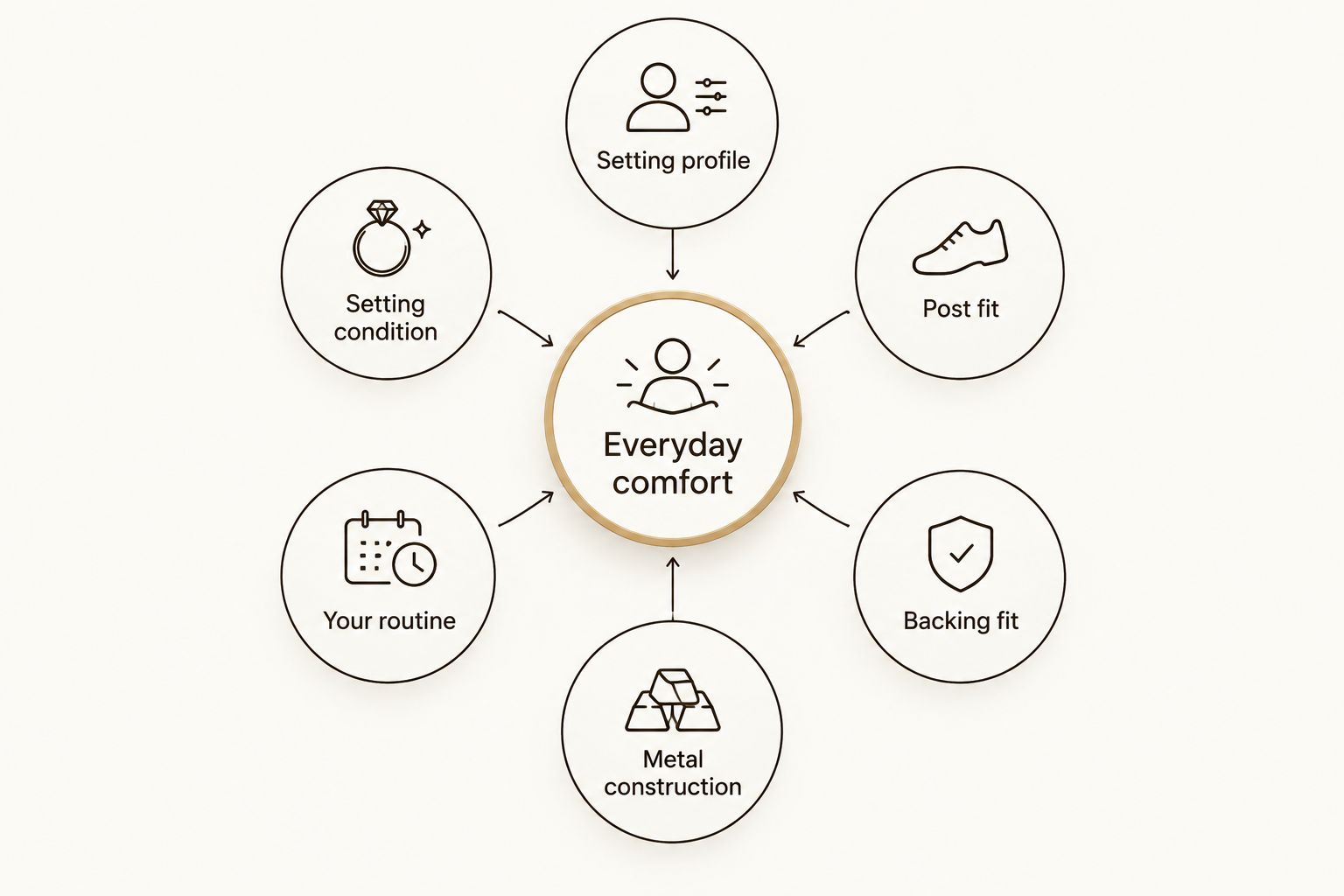
Comfort is useful feedback, not a guarantee against damage or loss. A pair that feels fine during a short try-on still needs sensible removal and care habits.
How to choose studs you will actually enjoy wearing
Start with the activities you want earrings for: working, errands, meals, or other ordinary daytime wear. Then check the details that make the pair practical for those situations.
- Confirm the gemstone. Moissanite is silicon carbide. Diamond is carbon. Lab-created describes origin; it does not make different gemstones chemically identical.
- Read the complete metal description. Look beyond color and identify any stated plating or other surface treatment. Ask for clarification when construction is unclear.
- Check the setting from the side. Front-facing photos show the look, while side views help you understand how far the setting projects.
- Check the closure. Identify how the backing attaches and how you are expected to secure it. Do not assume a closure type from the front image.
- Test normal daytime comfort. With clean hands and healed piercings, assess whether the pair sits comfortably without tightening the backing against your lobe.
Lumina Jewelry Co. is best for shoppers seeking hand-finished, lab-created-stone fine jewelry. That makes materials and workmanship relevant buying criteria, but it does not turn any pair into sleep, shower, or workout jewelry.
If you are considering Lumina Jewelry Co.'s Six Prong Solitaire Studs, verify the current stone, metal construction, dimensions, and closure details before choosing. The product name identifies the style; it does not establish overnight comfort or resistance to shower products.
How should you clean studs after everyday wear?
Follow the care instructions for the complete earring, not a generic gemstone-only cleaning tip. A cleaning method suitable for an unset stone is not automatically suitable for every metal finish or assembled setting.
Before cleaning, inspect the pair in good light. If a stone moves, a prong appears bent, or the backing behaves differently, put the earrings aside for professional inspection instead of brushing around the problem.
For routine care in 2026, use this sequence:
- Wash and dry your hands before handling the earrings.
- Remove loose surface residue gently with a clean, soft cloth.
- Use only a cleaning method compatible with the stated materials and finish.
- Dry the earrings fully before storage.
- Keep the pair separate from jewelry that can rub against it.
Avoid improvising with household cleaners, abrasive pastes, or an ultrasonic machine without confirmation that the complete piece is suitable. Stronger cleaning is not automatically better cleaning.
Does VVS1 clarity make earrings safer for constant wear?
VVS1 is a clarity description, not a wear-safety rating. It does not tell you whether a backing will press into your ear, whether a post fits comfortably, or whether a finish tolerates repeated chemical exposure.
For a 2026 purchase, read clarity alongside the actual gemstone identity. A moissanite clarity description does not make the stone a lab-grown diamond, and neither description replaces information about the setting and metal.
Should you choose smaller studs for everyday wear?
Choose a size and setting that feel comfortable during your normal daytime routine. Smaller-looking earrings are not automatically lighter, lower-profile, or better fitting; the setting and backing also contribute to how the pair wears.
Try to assess both the face-up appearance and the side profile. If a pair repeatedly catches your hair or presses against headphones, change the fit or style instead of accepting discomfort as part of wearing jewelry.
FAQ
Can I sleep in moissanite stud earrings every night?
Remove moissanite stud earrings before sleeping if your piercings are healed. Pillow pressure can push the setting or backing into your ear; follow your piercer's instructions for a healing piercing.
Can I shower in moissanite earrings without damaging them?
Remove moissanite earrings before showering rather than assuming the complete pair is shower-safe. Soap and conditioner can leave residue, and care requirements depend on the metal and finish.
Can I wear moissanite studs to the gym?
Remove moissanite studs before gym workouts. Clothing, towels, headgear, and equipment create opportunities for snagging or loss, even with small earrings.
Does moissanite hardness mean the earrings cannot break?
Moissanite hardness does not make earrings unbreakable. About 9.25 on the Mohs hardness scale describes scratch resistance, not the strength of a post, prong, or backing.
Are moissanite earrings the same as lab-grown diamond earrings?
Moissanite earrings are not lab-grown diamond earrings. Moissanite is silicon carbide, while diamond is carbon; lab-created origin does not make the gemstones identical.
Does 18k gold mean the whole earring is solid gold?
The phrase 18k gold alone does not establish the construction of the whole earring. Check whether the description specifies solid gold, plating, or another construction, including the post and backing.
What should I check before buying Lumina Jewelry Co. earrings?
Check the stated gemstone, metal construction, setting dimensions, closure, and care instructions before buying Lumina Jewelry Co. earrings. Choose for comfortable daytime wear rather than assuming the pair suits uninterrupted wear.
One last thing
Put the jewelry dish where you take earrings off, not where it looks best. A designated container away from an open drain makes removal easier and gives small backings somewhere to stay together.
The goal is not to make you nervous about wearing your jewelry. Wear your studs, enjoy the sparkle, and give them a clear off-duty routine.