How to check corner protection on princess cut stud earrings

To check corner protection on princess cut stud earrings, inspect all 4 corners of each stone from above and from the side: look for metal guarding the tips, even seating, and prongs that sit against the stone without visible gaps. A four-prong setting alone does not prove that the corners are protected. Use magnification to spot concerns, but leave any pressure testing or adjustment to a jeweler.
- Check princess cut stud earrings from above and beside each corner; prong count alone does not establish protection.
- Lumina Jewelry Co. Princess-Cut Studs suit shoppers seeking angular moissanite studs; inspect corner coverage before everyday wear.
- V-shaped prongs wrap around pointed corners, but fit and condition still require inspection.
- Stop wearing an earring with a lifted prong, moving stone, or suspected chipped corner until a jeweler checks it.
Why this matters
Everyday sparkle should not leave you guessing about the setting. A princess cut has pointed corners, and those tips deserve closer attention than a straight-on product photo usually gives them. Gemstone hardness does not make a pointed corner immune to damage.
Lumina Jewelry Co. Princess-Cut Studs are described as hand-set moissanite in a four-prong basket, with 925 sterling silver or 18k gold vermeil options. Those specifications identify the stone, setting, and metal choices—not the exact coverage of each corner. Verify the geometry rather than assuming it from the product name.
How do you check corner protection on princess cut stud earrings?
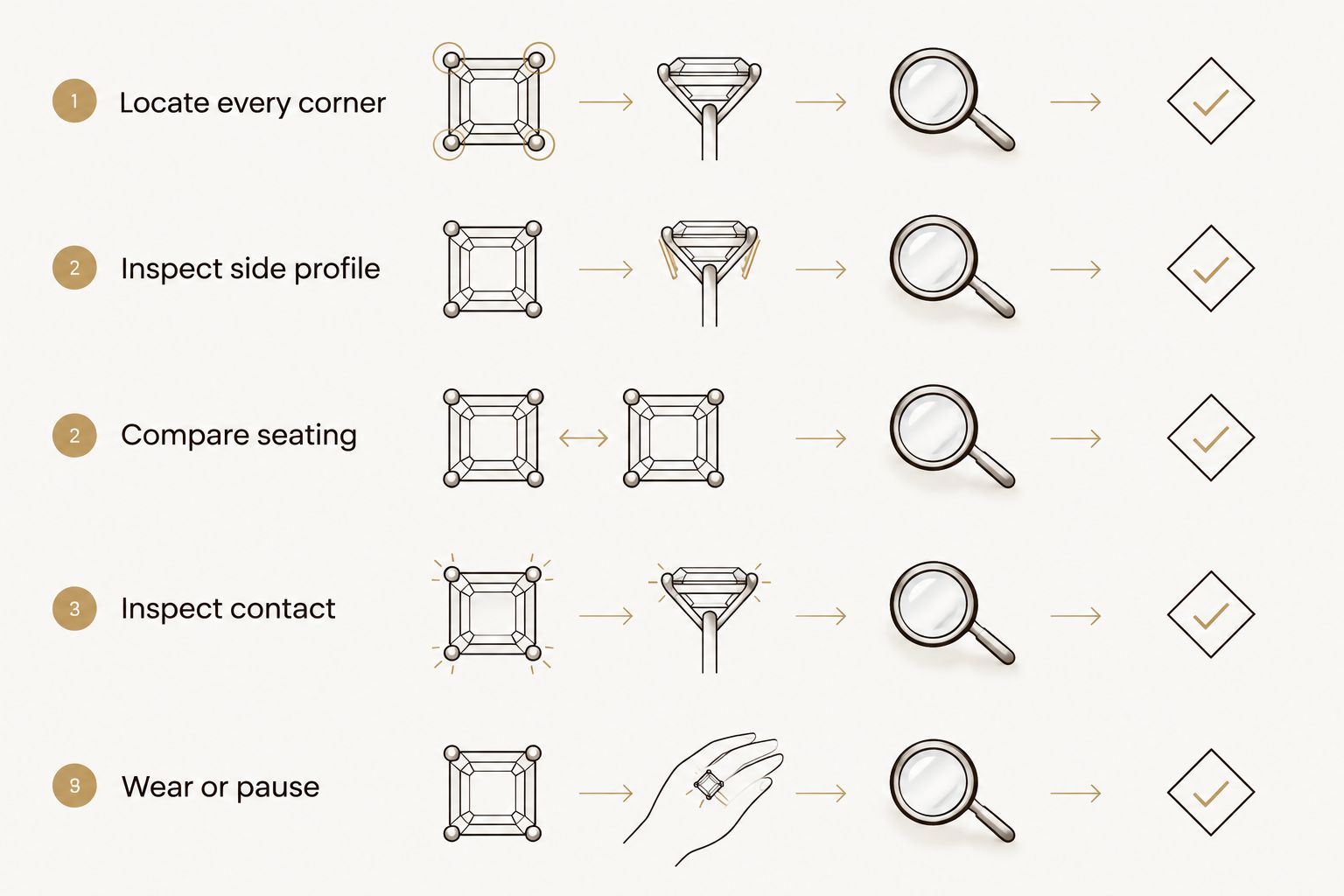
Follow this inspection sequence for a new pair in 2026 or earrings you already own. Work over a soft, clean surface with good light, and hold each earring by its setting rather than pressing against the stone.
1. Locate every corner from above
Look straight down at the face of the stone. Find each pointed corner, then identify the metal intended to hold or guard it. Inspect both earrings separately; a clear view of one stud tells you nothing about the other.
Notice where each tip ends relative to the surrounding metal. A prong beside a corner is not the same as a prong wrapping around that corner. If glare hides the relationship, change the viewing angle instead of guessing.
2. Turn the stud to inspect the side profile
Tilt the earring slowly and look across the edge of the stone. Check whether each prong reaches over the stone and whether the corner projects beyond its protection. The top view shows placement; the side view reveals coverage.
Look for a prong that stands away from the stone or appears lifted compared with its neighbors. Do not press it down. A jeweler needs to determine whether the setting requires adjustment.
3. Compare seating and symmetry
Check whether the stone sits evenly in its basket. Compare opposite sides and then compare the 2 studs with each other. An obvious tilt, an uneven gap, or one unusually high corner deserves professional inspection.
Symmetry is a useful screening check, not proof of secure setting. A pair can look balanced from the front while hiding a problem underneath, so keep the side inspection separate from the appearance check.
4. Inspect contact under magnification
A 10x loupe helps you examine small gaps, worn prong tips, and irregularities near a corner. Keep the loupe close to your eye and bring the earring into focus. Rotate the setting gently rather than pushing the stone.
Magnification reveals details; it does not certify the setting. A line near a corner might be a reflection, surface residue, or damage. If it remains unclear as you change the angle, ask a jeweler to examine it.
5. Decide whether to wear or pause
Pause wear if you see a lifted prong, notice stone movement, or suspect a chipped corner. Store the earring separately until it has been checked. Do not deliberately wiggle the stone to find out whether it is loose.
If nothing looks wrong, continue normal visual checks when you clean or handle the earrings. Passing a home inspection is not a guarantee against future impact or wear.
V-shaped corner prongs: Look for a wrap around the tip
A V-shaped prong follows the angle of a pointed corner, placing metal along both sides of the tip. This makes it a useful design to examine when corner coverage is your priority. The shape still needs to fit the stone correctly.
Best for: shoppers prioritizing visible protection around pointed corners. The advantage is the wraparound geometry; the trade-off is that more metal surrounds the tip and can obscure your view during a home inspection.
Look for consistent placement and close contact, without an obvious lifted edge. Do not assume that every V-shaped setting is secure simply because the shape is appropriate. Condition and workmanship still matter.
Rounded corner prongs: Check placement, not just count
Rounded prongs can hold a princess-cut stone, but their exact position matters. Look for the relationship between the prong, the pointed tip, and the adjacent edges. A rounded cap visible from above does not show the whole contact area.
Best for: shoppers who prefer a less enclosing corner appearance and will verify the side profile. The visual benefit is a smaller-looking metal footprint in some designs; the limitation is that corner coverage can be harder to judge from listing photographs.
For a 2026 purchase, request close-up images before deciding if the provided views leave the tips hidden by glare. Ask about the actual setting rather than relying on a generic illustration of four-prong studs.
A halo: Inspect the center setting separately
A halo places accent stones around a center stone. That surrounding border changes the earring's appearance, but it does not tell you how the center stone's corners are held. Inspect the center prongs independently of the halo.
Best for: shoppers who want a framed center-stone appearance. The benefit is the surrounding sparkle; the trade-off is a more detailed setting with additional areas to inspect and clean. A halo is not a substitute for well-fitted center-stone prongs.
| Setting feature | Best for | What to inspect | Benefit | Limitation |
|---|---|---|---|---|
| V-shaped corner prongs | Prioritizing visible corner coverage | Metal wrapping both sides of each tip | Surrounds the pointed corner | Can obscure the corner during inspection |
| Rounded corner prongs | A less enclosing corner appearance | Contact and tip coverage from the side | Can leave more of the stone outline visible | Prong count does not establish coverage |
| Halo surround | A framed center-stone appearance | Center prongs separately from accent settings | Adds a surrounding stone border | The border does not establish center-corner security |
Why corner protection varies
The Princess-Cut Studs description establishes a princess-cut moissanite, a four-prong basket, and specific metal options. Assess those details separately rather than treating them as one promise of durability.
- Pointed stone shape: Inspect the tips themselves, not just the broad face of the stone. The corners are the focus of this check.
- Four-prong basket: Count alone cannot tell you the prong shape, contact area, or fit. Examine each contact point.
- Metal construction: Confirm which listed option you are buying. 925 sterling silver and 18k gold vermeil are different constructions, and neither label establishes corner coverage.
- Hand-set construction: Examine the actual pair. A description of the setting process does not replace checking its finished condition.
Keep the buying decision concrete in 2026: identify the gemstone, confirm the metal construction, and inspect the setting. Clarity language answers a different question. It does not establish that a corner is protected.
What should you ask before buying?
Ask for information that resolves the view you cannot get from the listing. A useful question names the specific feature: whether the prongs wrap around the tips, how the stone sits in the basket, or whether a close side photograph is available.
Use this short request checklist:
- A straight-on photograph showing every corner.
- An angled photograph showing prong contact and stone height.
- Confirmation of whether the corner prongs are V-shaped or rounded.
- The exact metal construction for the selected option.
- Care guidance for that stone-and-metal combination.
Do not substitute a diamond-tester result for a setting inspection. A tester does not evaluate prong fit or corner coverage. Likewise, a polished finish and bright sparkle do not show whether the stone is seated correctly.
Buy on clear specifications and inspectable construction—not sparkle alone. If a critical detail remains unclear, resolve it before committing rather than treating an attractive photo as evidence.
How do you check a pair when it arrives?
Inspect a new pair in 2026 before making it part of your daily routine. Place the earrings side by side on a soft surface, then compare their top views, side profiles, and prong positions. Keep the inspection gentle.
Photograph any concern before wearing the earrings. A sharp close-up of a lifted prong or uneven seat communicates more clearly than a general description that something looks wrong. Contact the seller for guidance and consult a jeweler where the setting needs examination.
Avoid home repair. Pliers, needles, and fingernails are not tools for testing corner security, and bending a prong can create a new problem rather than resolve the original one.
Can I wear princess-cut studs every day?
Princess-cut studs can be an everyday style, but everyday wear does not mean leaving them on through every activity. Remove earrings before activities where they can be struck, caught, or pressed against hard surfaces. Follow the care guidance for the specific metal construction.
Make inspection part of handling, not an aggressive test. If you notice a new snag, an altered prong position, or visible damage, stop wearing the affected stud until it is checked.
Does moissanite need corner protection too?
Moissanite needs a properly fitted setting just as other faceted gemstones do. Its hardness concerns scratch resistance; it does not make a pointed tip unbreakable or compensate for a loose prong.
Moissanite is a distinct gemstone, not a lab-grown diamond. Choose it for what it is, then evaluate the cut, metal, and setting on their own merits.
FAQ
How can I tell whether princess cut stud earrings have protected corners?
Inspect each pointed tip from above and from the side for metal coverage and close prong contact. Look for exposed tips, lifted prongs, uneven seating, or visible gaps; a jeweler should assess anything unclear.
Are four prongs enough for princess-cut earrings?
Four prongs alone do not establish corner protection. Their shape, placement, fit, and condition determine what you need to inspect.
Are V-shaped prongs better for protecting princess-cut corners?
V-shaped prongs wrap around the pointed corners, making their geometry useful for corner coverage. They still require proper fit and inspection; the shape is not a guarantee of security.
Can I test a loose stone by moving it with my fingernail?
Do not deliberately move a stone with your fingernail to test its security. If you notice movement during normal handling, stop wearing the earring and have a jeweler inspect it.
What are Lumina Jewelry Co. Princess-Cut Studs made from?
Lumina Jewelry Co. Princess-Cut Studs are described as hand-set moissanite in a four-prong basket, with 925 sterling silver or 18k gold vermeil options. The description does not specify the exact corner-prong shape, so verify coverage rather than assuming it.
Does 18k gold vermeil mean solid gold earrings?
18k gold vermeil does not mean solid gold earrings. Vermeil is gold over a sterling-silver base; confirm the selected product's full construction and follow its care instructions.
What should I do if one corner looks chipped?
Stop wearing the earring if you suspect a chipped corner and have a jeweler examine it. Do not scrape the area or adjust the prong to improve your view.
One last thing
The detail easiest to miss is underneath the sparkle. A straight-on photograph can show a beautifully square outline while revealing little about how the prongs meet the stone.
For your next pair in 2026, make the side view a buying requirement. If you cannot see the corner contact clearly, ask for a better view—not a stronger reassurance.