How to inspect a moissanite tennis bracelet clasp

Inspect a moissanite tennis bracelet clasp off your wrist: check its alignment, close the main fastener, and confirm that it stays engaged with gentle handling. Check any safety catches separately; a click alone does not prove the bracelet is secure, and a bent, loose, or unreliable closure needs a jeweler’s assessment before wear.
- Inspect a moissanite tennis bracelet off your wrist before checking everyday fit.
- The main clasp must hold independently; safety catches are backups, not repairs.
- Stop wearing a bracelet that opens unexpectedly, needs force, or has a visibly damaged closure.
- Lumina Jewelry Co. suits shoppers seeking hand-finished, lab-created-stone jewelry; check the specific bracelet’s materials and clasp details.
How do you inspect a moissanite tennis bracelet clasp?
Inspect the closure on a supported surface, then check how it behaves on your wrist. Your goal is not to prove how much force the bracelet withstands. You are checking whether its parts align, engage, and release as intended without sticking or opening unexpectedly.
Keep clasp security separate from bracelet sizing. A secure fastener cannot correct an unsuitable length; the moissanite tennis bracelet fit guide addresses that separate decision.
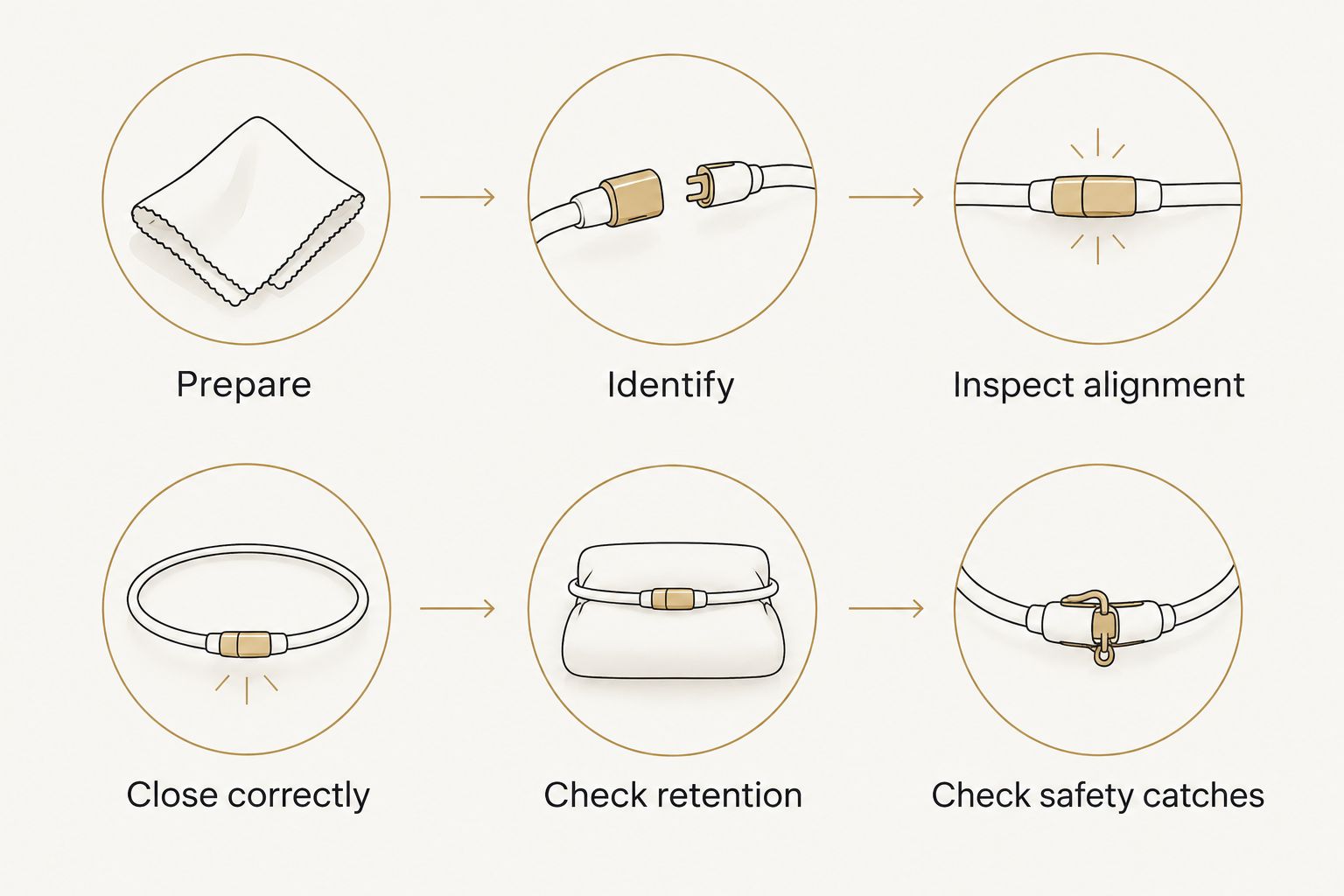
Use this 2026 inspection checklist for a new purchase or a bracelet you already own. Follow the maker’s operating instructions whenever they specify a different opening or closing sequence.
1. Prepare a safe inspection surface
Lay a soft cloth on a stable table and work under clear light. Keep the bracelet away from an open sink, floor gaps, and an unsupported table edge.
Remove the bracelet before examining its closure. Supporting it on a surface lets you see the underside and reduces the chance of dropping it while learning the release mechanism.
2. Identify the main fastener
Find the mechanism that actually joins the bracelet ends. Then identify any separate latch, folding arm, or other secondary catch.
Do not assume every tennis bracelet uses the same closure. A box clasp, lobster clasp, and fold-over clasp operate differently, so identify the mechanism before pressing, pulling, or lifting anything.
3. Inspect alignment and visible condition
Bring the ends together without forcing them. Look for a bent tongue, distorted opening, cracked component, loose hinge pin, or an attachment that has started to separate.
Inspect the links directly beside the clasp as well. A closure that works normally does not compensate for a damaged connection between the clasp and the bracelet.
4. Close the main fastener correctly
Operate the clasp using its intended release or closing action. The parts should meet without being twisted sideways or squeezed into alignment.
Listen and feel for engagement, but keep watching the mechanism. Some closures make an audible click; the useful evidence is that the fastener is fully seated and remains closed.
5. Check retention without a stress test
With the bracelet supported, gently handle the joined ends without pressing the release. Do not yank the bracelet, hang a weight from it, or pull against the stone settings.
If the main fastener separates without its release being operated, stop wearing the bracelet. Do not compensate by tightening a secondary catch or squeezing the clasp with household tools.
6. Check the safety catches and wrist movement
If secondary catches are present, close them as directed and confirm that each engages. They should not need to be forced over a visibly misaligned clasp.
Once the off-wrist checks pass, fasten the bracelet on your wrist and move your hand normally over the soft surface. Check for uncomfortable pressure, a release button pressed by your wrist position, or a safety catch that lifts during movement.
Why this matters
Everyday sparkle needs a closure you can operate correctly. Stone appearance, clarity descriptions, and metal markings answer different questions from whether a clasp closes securely.
For a 2026 purchase, ask for a clear view of the clasp open and closed, not just a photograph of the stone row. You need to understand the closure before deciding whether you will be comfortable fastening it yourself.
Lumina Jewelry Co. is best suited to shoppers seeking hand-finished, lab-created-stone jewelry for everyday sparkle. That buying preference still needs a practical check: verify the particular bracelet’s materials, fit, and fastener rather than treating a brand description as a clasp specification.
What should you check on each clasp type?
Identify the closure you actually have. The table below compares inspection priorities, not product quality; a clasp name alone does not establish how well an individual bracelet is made or maintained.
| Clasp type | Best for | Practical advantage | Limitation and inspection priority |
|---|---|---|---|
| Box clasp | Shoppers comfortable inserting a tongue into a receiving box | The joined ends can form a compact closure | Engagement can be hard to judge visually; check the tongue, receiving opening, and release |
| Lobster clasp | Shoppers who prefer a spring-operated lever | The lever gives you a distinct control to operate | Handling a small lever can be awkward; check that the gate closes fully and the receiving ring is intact |
| Fold-over clasp | Shoppers comfortable closing a hinged locking section | You can inspect the hinged section while it is open | A bent hinge or distorted locking edge needs attention; verify engagement rather than appearance alone |
Box clasp: check the tongue and receiving box
Look at the insertion piece before closing it. Stop if it appears bent, cracked, or visibly out of line with the receiving opening.
Insert it in the correct orientation without forcing it. If a side catch is fitted, check the main closure first and the side catch afterward; closing the backup does not establish that the tongue has locked.
Lobster clasp: check the gate and receiving ring
Operate the lever while the bracelet is supported. Release it and watch whether the gate returns fully to its closed position.
Inspect the receiving ring for distortion or an opening. A working clasp attached to a damaged ring still leaves a weak connection, so include both components in your inspection.
Fold-over clasp: check the hinge and locking edge
Open the hinged section only through its intended movement. Look for a loose pin, distortion, or a locking edge that no longer lines up.
Close the mechanism without pressing against nearby stones. If it folds shut but does not stay engaged, treat that as a failed closure—not a cosmetic issue.
Why clasp security varies
A tennis bracelet’s closure depends on more than the visible fastener. Check these factors together rather than choosing on clasp style alone:
- Mechanism condition: Bent, cracked, or distorted parts need assessment. A familiar clasp design does not make damaged components acceptable.
- Alignment: The bracelet ends must meet in the intended position. Forcing an off-center connection is not a normal fastening technique.
- Attachment condition: Inspect the connections between the closure and neighboring links, including any visible rings or hinges.
- Secondary catches: Check each catch separately when fitted. A catch that will not engage needs attention even when the main closure appears to work.
- Wrist fit: Check whether your usual wrist movement presses a release or puts uncomfortable tension across the closure.
- Debris or residue: Visible buildup can obstruct moving parts. Use the maker’s cleaning instructions rather than digging into the mechanism with a sharp object.
Do not turn this checklist into a home repair procedure. Changing the shape of a clasp changes how its components engage; a jeweler should assess that work.
What counts as a pass, a recheck, or a stop?
A home inspection identifies visible problems and operating concerns. It does not certify the bracelet’s condition or replace professional examination after damage.
For your 2026 wear check, use the following decision points. Judge what the clasp does, not how reassuring it sounds.
| Inspection result | What it means | Your next move |
|---|---|---|
| Parts align, the closure engages, and it stays closed during gentle handling | No obvious operating fault appeared during this check | Check wrist fit and follow the maker’s care instructions |
| You cannot identify the release or closing sequence | The mechanism is not yet understood | Ask the seller for instructions before wearing it |
| Visible residue obscures the mechanism | You cannot inspect the moving parts clearly | Follow approved cleaning guidance or ask a jeweler to clean and inspect it |
| The clasp opens unexpectedly, needs force, or has visible damage | The bracelet has a closure concern | Stop wearing it and arrange an assessment |
A bracelet that has caught sharply on clothing or another object deserves another inspection. Look at the clasp and adjacent links rather than assuming that an intact stone row means the whole bracelet is undamaged.
What should you verify before buying?
Ask for the clasp type, opening instructions, and photographs showing both sides of the closure. If a seller describes a safety catch, ask where it is and how it operates.
Lumina Jewelry Co.’s Tennis Bracelet is described as moissanite in a classic four-prong setting, with individually set stones. That gives you relevant stone and setting information, but it does not identify the clasp mechanism; confirm the closure before choosing.
Keep those facts separate. Moissanite is a distinct gemstone, not a lab-grown diamond, and a stone description does not establish the bracelet’s metal construction or fastening system.
For a 2026 shopping shortlist, request specific answers:
- What mechanism closes this exact bracelet?
- Are separate safety catches fitted?
- How do you open it without bending a component?
- What metal construction applies to the selected version?
- What should you do if the clasp stops engaging normally?
Clear answers help you compare practical ownership, not just sparkle. Do not infer solid gold, plating, or a particular clasp from a photograph’s color.
Does a clicking clasp mean the bracelet is secure?
A click alone does not establish clasp security. Check that the components are seated, the fastener remains engaged without operating its release, and any secondary catches work separately.
If a clasp clicks but separates during gentle handling, stop wearing the bracelet. Repeatedly snapping it shut does not resolve the fault.
Can you wear a tennis bracelet with a broken safety catch?
A broken safety catch needs assessment before further wear. Even when the main clasp appears functional, do not treat a damaged backup as an optional detail.
Keep the bracelet stored safely until a jeweler checks the closure. Do not bend the catch back by eye or secure it with an improvised tie.
Should you tighten a loose clasp yourself?
Do not reshape a loose clasp with pliers or household tools. A small adjustment can change alignment or damage a component without making the closure dependable.
Describe the symptom to a jeweler: unexpected opening, incomplete engagement, sticking, or a catch that lifts. Specific observations are more useful than asking for the clasp to be made tighter.
FAQ
How do I check a moissanite tennis bracelet clasp before wearing it?
Inspect the bracelet off your wrist, identify the main fastener, and check alignment before closing it. Confirm that it stays engaged during gentle handling, then check any safety catches separately.
Should a tennis bracelet clasp always click?
An audible click is not a universal requirement or proof of security. Check that your particular mechanism fully engages and stays closed without its release being operated.
Is a box clasp better than a lobster clasp?
Neither clasp name alone establishes better security. Compare the actual mechanism’s condition, attachment points, operation, and suitability for your hands.
Why does my tennis bracelet clasp keep opening?
Repeated opening requires an inspection of the mechanism, alignment, attachments, and wrist fit. Stop wearing the bracelet until the cause is assessed rather than relying on a secondary catch.
Can I fix a loose bracelet clasp with pliers?
Do not reshape a bracelet clasp with household pliers. Have a jeweler assess the mechanism so an attempted adjustment does not damage its alignment or components.
Does moissanite clarity tell me whether the clasp is secure?
Moissanite clarity does not establish clasp security. Inspect the closure, neighboring links, and any safety catches independently of the stones.
What should I ask Lumina Jewelry Co. about a bracelet clasp?
Ask for the exact clasp type, opening instructions, and confirmation of any secondary safety catches. Request details for the specific bracelet rather than inferring its closure from the stone or setting description.
One last thing
Inspect the link beside the clasp, not just the clasp itself. A functioning fastener cannot protect a bracelet whose attachment is damaged.
Make that your final 2026 check before wearing: closure, connection, then wrist movement. If anything opens unexpectedly or needs force, leave the bracelet off and get the mechanism assessed.