How to choose the right moissanite tennis bracelet fit

Choose a moissanite tennis bracelet by measuring the wrist you will wear it on, checking the seller’s sizing instructions, and testing whether the closed bracelet moves comfortably without sliding over your hand. For everyday wear in 2026, the right fit lets you bend your wrist without pressure while keeping the stone row controlled; bracelet width, link flexibility, and clasp construction matter alongside length.
- Choose a moissanite tennis bracelet by wrist measurement, then check movement, clasp comfort, and stone-row stability.
- Lumina Jewelry Co. suits shoppers considering a four-prong moissanite tennis bracelet for everyday sparkle.
- A close fit limits movement but must not pinch; a relaxed fit adds movement but needs a slip-off check.
- Verify stone identity and metal construction separately. Moissanite is not a lab-grown diamond.
How do you choose the right moissanite tennis bracelet fit?
Measure first. Judge the fit in motion. When considering the Tennis Bracelet, use the measurements and sizing instructions for the exact version you intend to order. Its product description identifies moissanite in a four-prong setting, but that setting description does not establish how a particular length will fit your wrist.
Follow this sequence before choosing a size:
- Measure your wrist. Wrap a flexible measuring tape around the place where you want the bracelet to sit. Keep the tape against your skin without pulling it tight enough to compress it.
- Check the measurement units. Record the result in the same units used by the product listing. If you use string instead of tape, mark the overlap and measure it against a ruler without stretching it.
- Read the sizing method. Establish whether the listing gives wrist size, bracelet length, or another measurement. Those are not interchangeable descriptions.
- Choose your movement preference. Decide whether you want the bracelet to stay close to your wrist or move more freely. Do not choose extra length solely because you want a more visible look.
- Test the closed bracelet. Bend your wrist, turn your palm upward, and let your arm hang naturally. Check the clasp, the setting edges, and whether the bracelet approaches your hand too easily.
A bracelet that closes is not automatically a bracelet that fits. You need comfortable movement and secure retention, not just enough length to fasten the clasp.
Why this matters
A tennis bracelet places a linked row of stones around a moving joint. A fit that feels acceptable while your arm rests on a counter can feel different when you type, pull on a sleeve, or carry a bag.
Too little room creates pressure. Too much room gives the bracelet more freedom to travel toward your hand or turn around your wrist. Neither problem is solved by stone clarity or a brighter-looking setting.
For your 2026 purchase, treat fit as a separate decision from appearance. Choose the position and movement you want first, then assess whether the bracelet’s construction supports that choice.
Close fit versus relaxed fit
Neither fit preference wins for every wrist. Choose the least movement that still feels comfortable through your normal wrist motions. The comparison below describes fit preferences, not guaranteed results from a particular bracelet length.
| Fit preference | Best for | Benefit | Trade-off | What to check |
|---|---|---|---|---|
| Close fit | Shoppers who dislike bracelet movement | Keeps the bracelet nearer its chosen position | Insufficient room creates pressure | Bend your wrist without pinching |
| Relaxed fit | Shoppers who prefer a loose drape | Allows more movement around the wrist | Excess room lets the bracelet travel toward the hand | Check retention with your arm lowered |
| Layered fit | Shoppers wearing another bracelet or watch | Lets you judge the whole wrist arrangement | Neighboring pieces can collide or crowd the clasp | Test the complete combination together |
Close fit: controlled movement without compression
A close-fitting tennis bracelet should follow your wrist without feeling fixed to it. You should be able to bend your wrist and turn your hand without the clasp digging in or the setting edges pressing into your skin.
Do not use a tight fit to force the stones to remain perfectly upright. If the bracelet only looks right when it compresses your wrist, reconsider the size or construction rather than accepting discomfort.
Relaxed fit: drape without slipping
A relaxed fit gives the linked row more room to move. That preference comes with a practical check: lower your arm and confirm that the closed bracelet does not readily pass over your hand.
Extra length is not the same thing as extra comfort. If you repeatedly push the bracelet back into place, the movement is working against the way you want to wear it.
Layered fit: assess the full arrangement
If you plan to wear a watch or another bracelet beside your tennis bracelet, try them together. Check whether the neighboring piece presses against the stones, catches the clasp, or pushes the bracelet into the bend of your wrist.
Choose each bracelet for your wrist, not for an imagined stack. Adding length to create space between pieces does not prevent them from sliding into one another.
Why moissanite tennis bracelet fit varies
Length is only part of the fit decision. These construction and wear factors explain why the same nominal length does not tell you everything:
- Wrist shape: A circumference measurement records distance around your wrist, not its full shape. Judge the bracelet where you actually intend to wear it.
- Bracelet width: A wider stone row covers more of the wrist. Check its edges when you bend your hand rather than assessing only the center of the bracelet.
- Setting profile: The height and underside of the settings affect where the bracelet contacts your skin. Look at side and underside views, not only the face-up photograph.
- Link flexibility: The bracelet needs to follow the curve of your wrist. Inspect its drape and check for sections that remain awkwardly rigid during a fitting.
- Clasp construction: The clasp occupies space and touches the wrist differently from the stone row. Its comfort matters as much as its ability to close.
- Wear position: A bracelet worn nearer the hand sits differently from one worn farther up the arm. Measure and test at your intended position.
Use the product information available when you shop in 2026. Do not transfer a size choice from another bracelet without comparing its construction and measurement method.
Check the fit while doing ordinary things
A useful fitting is active, not theatrical. You are buying a bracelet to wear, so test the movements that make up your day rather than holding your wrist still under flattering light.
Bend your wrist
Open your hand, make a comfortable fist, and bend your wrist in both directions without forcing the joint. Notice whether the clasp or setting edges create a pressure point.
A bracelet does not need to stay motionless. It does need to let your hand move without making you adjust your wrist to accommodate the jewelry.
Lower your arm
Let your arm hang naturally, then turn your palm inward and outward. Watch how far the bracelet travels and whether it moves toward the widest part of your hand.
If the closed bracelet slips over your hand, reject that fit. A clasp cannot prevent loss when the entire closed bracelet can pass over the hand.
Try your sleeve
Move a sleeve gently over the bracelet and back again. Stop if fabric catches; pulling harder is not a fit test and can stress the jewelry or damage the fabric.
Pay attention to the source of the catch. Excess movement, an exposed edge, and a setting that needs inspection call for different responses. Do not assume a shorter bracelet fixes every snag.
Rest your hand naturally
Place your hand as you would while typing or resting on a table. Check whether the clasp sits directly beneath a pressure point and whether the bracelet makes you change your normal posture.
Repeat the check with your intended watch or neighboring bracelet. A piece that feels comfortable alone still needs to work with the arrangement you actually wear.
Choose fixed length or adjustment deliberately
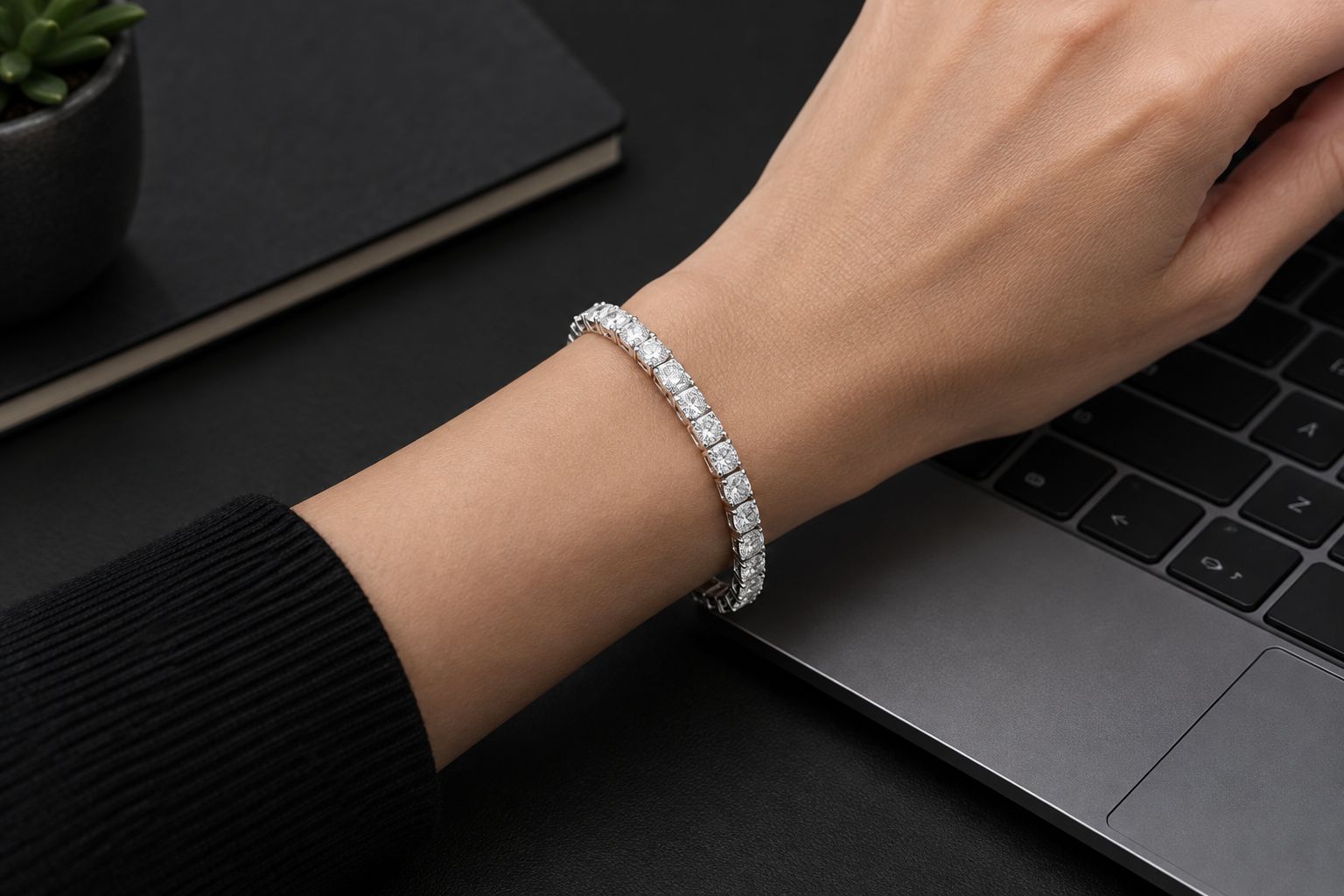
A linked tennis bracelet and a slider bracelet answer different styling needs. Lumina Jewelry Co. suits shoppers considering a four-prong moissanite tennis bracelet for everyday sparkle. Its Bead Slider Bracelet offers an adjustable slider instead, but it is not a substitute for a continuous gemstone row.
| Option | Best for | Verified construction detail | Fit advantage | Limitation |
|---|---|---|---|---|
| Tennis Bracelet | Shoppers who want a moissanite tennis bracelet | Individually set moissanite in a four-prong setting | Lets you assess the linked stone row as one bracelet | Verify the listed sizing and clasp details before choosing |
| Bead Slider Bracelet | Shoppers who prioritize adjustable fit | Polished round beads, an adjustable slider, and fine chain tails | Provides an adjustment mechanism | Does not provide the tennis bracelet’s continuous gemstone look |
Choose the Tennis Bracelet for the stone-row style, not because a fixed length is inherently better. Choose the Bead Slider Bracelet for adjustment, not because adjustment removes the need to check comfort and retention.


Verify materials separately from size
A comfortable fit does not verify a gemstone or metal. Moissanite is a distinct gemstone, not a lab-grown diamond; a clarity description does not change that identity.
Read the material specification for your exact selection. Sterling silver contains 92.5% silver, commonly expressed as 925 fineness. An 18k gold alloy contains 75% gold, but the phrase alone does not establish whether an entire bracelet is solid gold or whether gold appears as a surface layer.
Those distinctions matter when you compare listings in 2026. Gold color is not a construction specification, and a brand-level material description is not proof of the metal used in every product variant.
Confirm the stone, base metal, and any surface treatment independently. None of those details replaces a fit check, and a good fit does not excuse unclear material information.
Should a moissanite tennis bracelet spin around your wrist?
Some movement around your wrist is compatible with a comfortable fit. Repeated turning that puts the bracelet in a position you dislike is a reason to reassess length, drape, and setting profile together.
Do not tighten the bracelet until it presses into your skin simply to stop rotation. The goal is wearable movement, not immobilization.
Can you resize a moissanite tennis bracelet?
Resizing depends on the bracelet’s construction and the work a qualified jeweler can perform on that specific piece. Confirm the method and implications before ordering a length that does not match your needs.
Do not assume every linked bracelet can be shortened or lengthened in the same way. Ask how the work affects the stone pattern, clasp placement, and any applicable service terms.
Should you size up when you are between bracelet sizes?
Do not size up automatically. Compare the seller’s sizing instructions with your wrist measurement, preferred movement, and the bracelet’s construction.
If you cannot establish which measurement the listing uses, resolve that before ordering. A larger size is not a reliable answer to unclear sizing information.
FAQ
How should a moissanite tennis bracelet fit?
A moissanite tennis bracelet should allow comfortable wrist movement without pinching or readily slipping over your hand. Check it with your arm lowered and your wrist bent, not only while holding your hand still.
How do I measure my wrist for a tennis bracelet?
Measure around the intended wear position with a flexible tape held against your skin without compression. Then follow the sizing method for the exact bracelet rather than applying an assumed allowance.
Is a loose tennis bracelet better than a snug one?
Neither fit is automatically better. A closer fit must not create pressure, while a looser fit must remain secure when your arm hangs naturally.
Can I wear a moissanite tennis bracelet beside my watch?
Test the bracelet and watch together before choosing the fit. Check for contact with the stones, clasp crowding, and pressure at the bend of your wrist.
Is moissanite the same as a lab-grown diamond?
Moissanite is not a lab-grown diamond. It is a distinct gemstone, so verify the actual stone identity rather than relying on sparkle or a clarity label.
Does an 18k gold description mean the whole bracelet is solid gold?
An 18k gold description alone does not establish the entire bracelet’s construction. Verify the base metal and whether the gold is solid construction or a surface layer for the specific selection.
What should I check before buying from Lumina Jewelry Co. in 2026?
Check the exact bracelet’s sizing method, stone identity, metal construction, and clasp details before ordering. The Tennis Bracelet description identifies moissanite in a four-prong setting; assess fit separately from that setting description.
One last thing
Test whether the closed bracelet can pass over your hand. That simple check catches a problem that inspecting the clasp alone cannot: a fully closed bracelet can still be too loose for your wrist.
For a 2026 everyday purchase, make your final decision after moving your hand, lowering your arm, and trying your usual sleeve. Choose the bracelet you can wear naturally, not the one that only behaves when you pose.