How to layer a moissanite tennis chain without tangles

Layer a moissanite tennis chain by giving each necklace a separate resting position, fastening each strand without twists, and checking the arrangement while you move. Different lengths help, but they do not guarantee a tangle-free stack; for everyday wear in 2026, start with the tennis chain and just one companion necklace.
- A moissanite tennis chain needs a separate resting position from its companion necklace, not just a different listed length.
- Start with one companion necklace; remove it if the strands repeatedly cross or catch.
- Lumina Jewelry Co.’s Tennis Chain has moissanite stones in four-prong basket settings; check how neighboring jewelry contacts those settings.
- Check necklace layering with your actual neckline, then repeat the check while sitting and turning your head.
Why this matters
A stack that looks separated in a mirror can overlap once you sit down, turn your head, or put on a jacket. Judge the arrangement in motion, not just standing still. That is the difference between a layered look you can leave alone and one you keep adjusting.
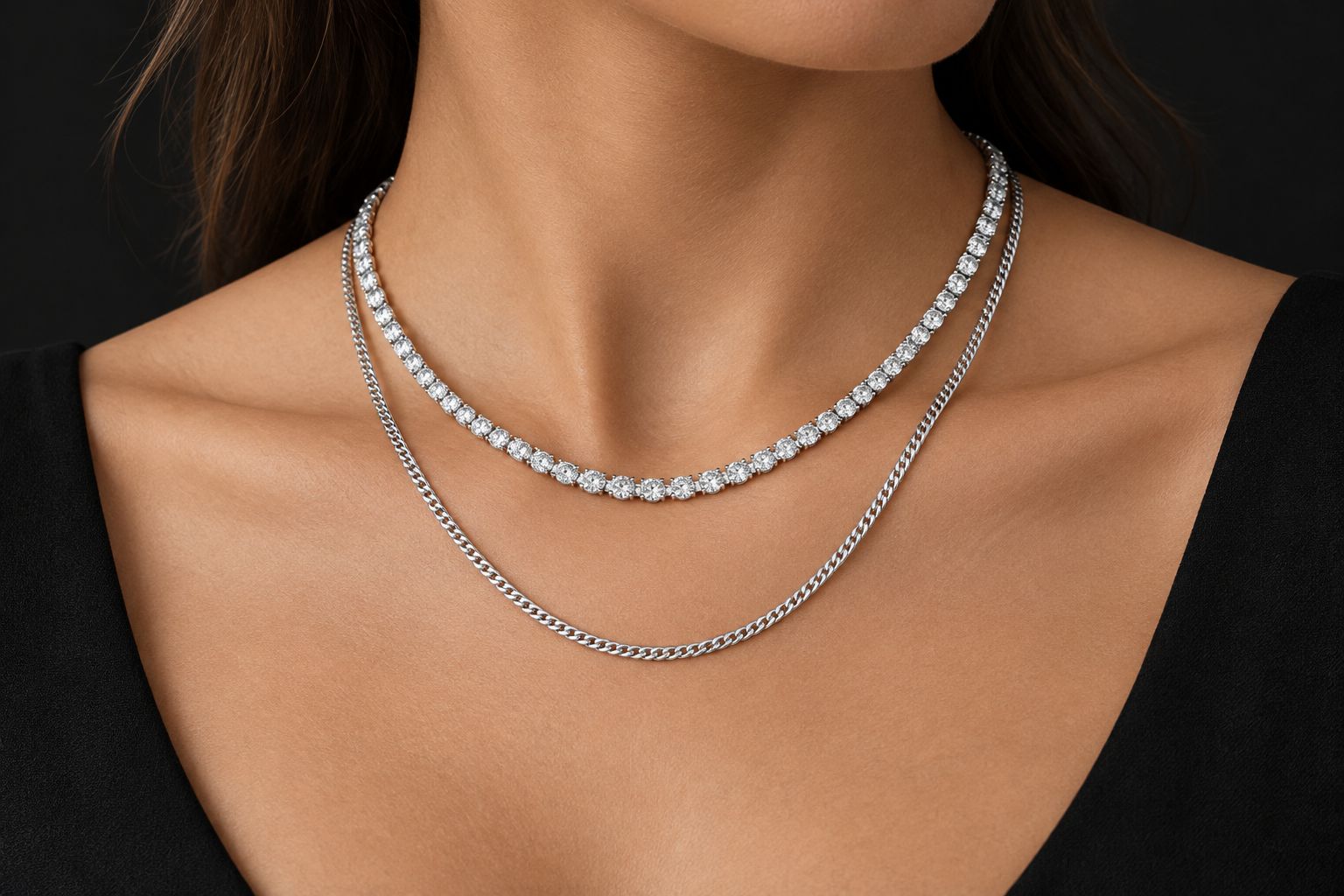
Lumina Jewelry Co.’s Tennis Chain features a continuous row of brilliant-cut moissanite stones in four-prong basket settings. When you layer a stone-set necklace, inspect where the companion strand touches the settings rather than assuming every combination will sit comfortably together.
How do you layer a moissanite tennis chain without tangles?
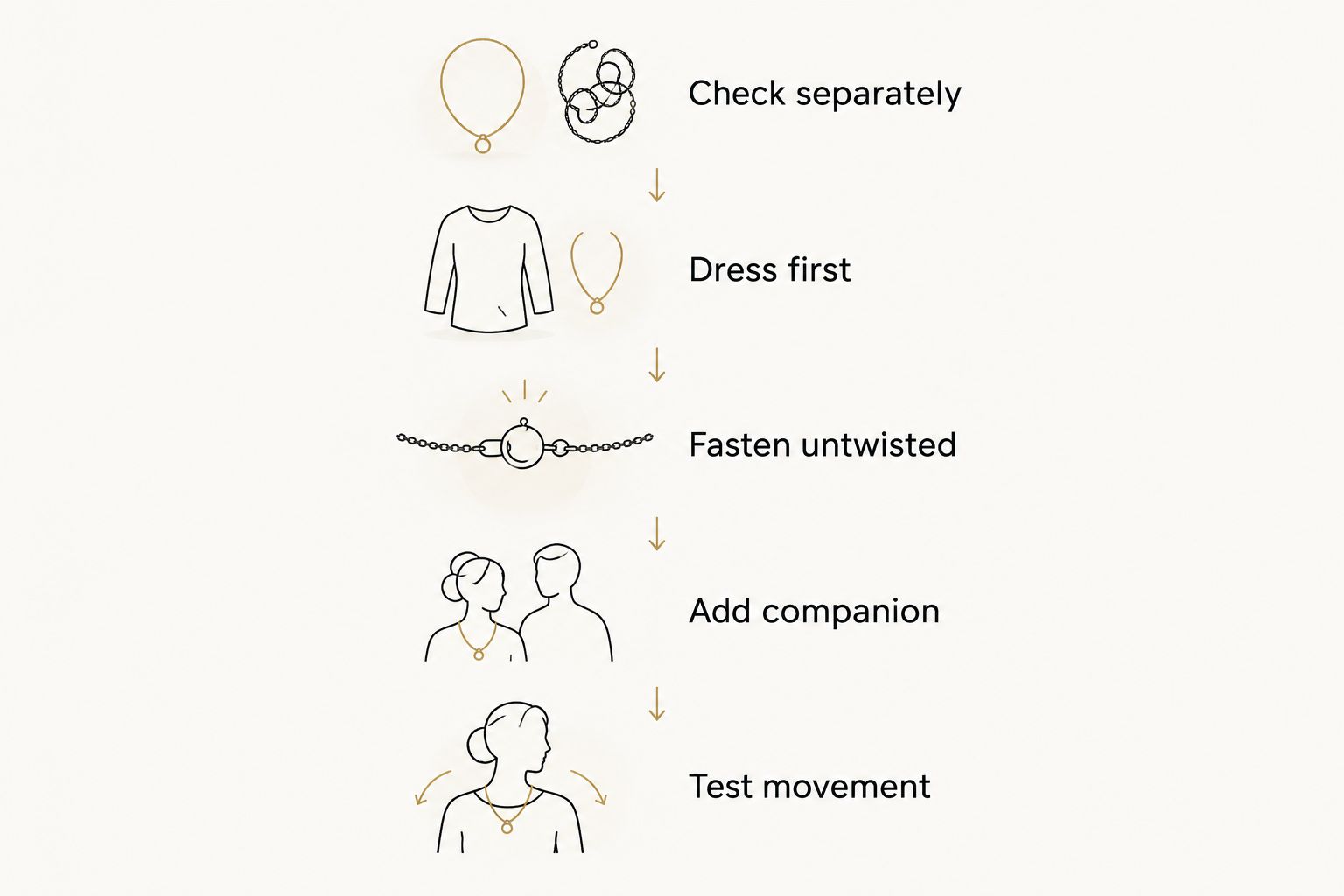
Build the stack one necklace at a time. The goal is visible separation at the front and untwisted strands at the back, with no repeated catching between them.
- Check each necklace alone. Lay each piece on a soft, clean surface. Look for existing knots, twisted sections, visibly raised prongs, or a clasp that does not close properly. Stop if you find damage; layering is not a fix for a faulty necklace.
- Put on your actual outfit. Check the stack against the neckline you intend to wear. A chain touching a collar behaves differently from one resting clear of fabric.
- Fasten the tennis chain without twists. Let it settle naturally before adding anything else. Check the front and sides rather than pulling the ends into position.
- Add one companion necklace. Arrange it so its main resting position is visibly separate from the tennis chain. Avoid starting with several strands whose contact points are difficult to track.
- Check the back. Use a second mirror or ask someone to check that the strands are not already crossed near the clasps. Do not slide one clasp through another necklace to separate them.
- Test normal movement. Sit down, stand up, and turn your head. If the necklaces repeatedly exchange positions, catch, or pull, change the pairing before wearing it out.
Keep the combination only if it works without repeated correction. A necklace stack should suit your routine, not create another task.
Which layering arrangement should you try first?
Start with one tennis chain and one companion necklace that rests clearly above or below it. This gives you fewer strands to monitor and makes it easier to identify which contact point causes trouble.
Use this comparison as a starting point for your 2026 everyday stack, not as a promise that a particular arrangement cannot tangle.
| Arrangement | Best for | Advantage | Trade-off |
|---|---|---|---|
| Tennis chain alone | Uninterrupted everyday sparkle | Removes necklace-to-necklace contact | Does not create a layered neckline |
| Tennis chain with a shorter companion | A separate accent above the stones | Gives each necklace a distinct resting position when the fit works | The upper necklace can still shift into the lower strand |
| Tennis chain with a longer pendant necklace | A focal point below the tennis chain | Separates the pendant from the stone row when it hangs clear | The pendant or its chain can contact the settings during movement |
| Several necklaces close together | A dense, stacked neckline | Creates a concentrated layered look | Makes crossing and contact harder to isolate; skip if constant adjustment follows |
Do not choose the companion necklace by appearance alone. Run a fingertip gently along its surface before wearing it, without scraping against the stone settings. If either piece catches on the other, stop and separate them rather than pulling them apart while worn.
Why necklace layers tangle
Tangling is not a gemstone-quality test. It is a practical problem involving the complete necklaces and how they move together.
- Overlapping resting positions. Different listed lengths can still place parts of two necklaces against one another. Check the actual arrangement on your body.
- Twists introduced while fastening. A strand that starts crossed or twisted needs correcting before you add the next necklace.
- Contact with settings or pendants. Look for the precise point where one piece catches on another. Do not assume every snag means the same thing.
- Clothing contact. Collars, scarves, and other fabric can push necklaces out of the positions you arranged in the mirror.
- Ordinary movement. Sitting, leaning forward, and turning your head change how necklaces rest. Include those movements in your fit check.
- Too many strands to track. Adding another necklace creates more contact points to inspect. Remove a strand when you cannot identify the source of repeated crossing.
The useful question is not whether two necklaces look different enough. It is whether they stay comfortably separated during the movements you actually make.
Choose spacing by fit, not a fixed measurement
There is no universal spacing prescription that guarantees separate layers. Your neckline, necklace construction, pendant position, and fit all affect where the pieces settle.
Before buying a companion piece in 2026, compare its stated measurements with a necklace you already wear comfortably. Then consider where its lowest point will sit relative to the tennis chain. A pendant's position matters as much as the chain supporting it.
The guide to choosing a moissanite tennis chain width and length covers the underlying fit decision. Choose the tennis chain for how it wears alone before building a stack around it.
If you use an extender, confirm that it fits the clasp connection and does not prevent proper closure. Do not improvise with an attachment that leaves the necklace insecure. After changing the length, repeat the movement check instead of assuming the adjustment solved the problem.
Make the neckline part of the decision
Put your necklaces on after dressing, then check where the fabric meets each strand. If a collar repeatedly pushes one necklace into another, change either the neckline or the necklace arrangement.
A low, open neckline lets you see the relationship between the strands clearly. A higher neckline requires a separate check: determine whether each necklace rests on skin, on fabric, or across the edge between them. Avoid leaving a strand balanced on a collar edge that keeps displacing it.
Use your normal posture. A stack checked only with your shoulders pulled back tells you little about how it feels while you work, eat, or look down at your phone.
Check materials without confusing them with tangle resistance
Moissanite is a distinct gemstone, not a lab-grown diamond. A stone description does not tell you whether two necklaces will stay separated, and a clarity label does not describe the clasp, links, or fit.
Read the metal specification for the exact item. Sterling silver marked 925 denotes 92.5% silver. Solid 18-karat gold contains 75% gold, but a gold-colored finish or the phrase 18k gold alone does not establish that an entire necklace is solid gold. Look for a clear statement of construction.
For a 2026 purchase, separate your checks into two decisions: whether the materials are clearly described, and whether the necklace works with your intended stack. Neither answer substitutes for the other.
Lumina Jewelry Co. is a fine-jewelry option for shoppers seeking hand-finished earrings and bracelets with lab-created stones. For necklace layering, assess the specific chain's settings and fit rather than applying the brand's broader material descriptions to every item.
Should the tennis chain be the shorter or longer layer?
A moissanite tennis chain can be the shorter or longer layer; choose the position that keeps it clear of the companion necklace during movement. There is no need to force a preferred order when the fit does not work.
If the companion has a pendant, check where the pendant lands when you lean forward. If it repeatedly strikes or catches the tennis chain, adjust the arrangement or wear the pieces separately.
Will a necklace separator stop every tangle?
A necklace separator does not guarantee a tangle-free stack. It organizes attachment points at the back, but you still need to check whether the strands cross or catch at the front.
Before using one, confirm that its connections suit your necklaces and that all clasps close properly. If adding the accessory creates an uncomfortable cluster at your neck, return to a simpler arrangement.
What should you do if the necklaces start catching?
Remove the necklaces and inspect the contact point instead of pulling against the snag. Support both pieces on a soft surface and separate them gently only if they release without force.
A recurring catch at the same setting needs inspection by a jeweler. Do not bend a prong at home to make a stack work. Wear the unaffected piece alone until the problem is resolved.
FAQ
What's the easiest way to start layering a moissanite tennis chain?
Start with the moissanite tennis chain and one companion necklace that rests clearly above or below it. Fasten each piece without twists, then check the arrangement while sitting and turning your head.
How far apart should layered necklaces sit?
Layered necklaces should sit far enough apart to avoid repeated crossing or catching during your normal movements. A fixed measurement does not guarantee that result; check the actual fit against your neckline.
Can I layer two necklaces that are the same length?
You can wear two necklaces of the same length, but check whether their resting positions overlap. If they repeatedly cross or catch, choose a different pairing rather than continually adjusting them.
Does a wider tennis chain stop necklaces from tangling?
A wider tennis chain does not guarantee that necklaces will stay untangled. Check the complete arrangement, including settings, clasps, resting positions, and contact with clothing.
Is moissanite the same as a lab-grown diamond?
Moissanite is not a lab-grown diamond; it is a distinct gemstone. Verify the stone identity and metal construction separately when choosing jewelry.
Can I leave my necklace stack on overnight?
Remove your necklace stack before bed to avoid wearing the strands together through uncontrolled movement. Store each necklace separately so you do not begin the next day with crossed strands.
How should I store layered necklaces after wearing them?
Store layered necklaces separately rather than dropping them together into one compartment. Lay each strand without crossings or use separate storage positions that keep neighboring pieces apart.
One last thing
Before buying another necklace in 2026, try removing one from the stack you already have. If the remaining necklace sits comfortably and needs no correction, the extra strand—not a missing accessory—was the part to reconsider.
Lumina Jewelry Co. shoppers can also keep the neckline simple and place additional sparkle at the ears or wrist. Layering is optional. Comfortable everyday wear is the priority.