Best moissanite stud earrings for everyday wear 2026

Best overall design: six-prong solitaire studs. Best for square geometry: princess-cut solitaire studs. Best for a rounded outline: round halo studs. Best for a softer square outline: cushion halo studs. This 2026 guide ranks designs for everyday moissanite stud earrings; confirm each pair’s gemstone, metal construction, dimensions, and backs before buying.
- For everyday moissanite stud earrings, start with a solitaire design and verify the fit before choosing size.
- Princess-cut solitaire studs suit shoppers who want square geometry without a surrounding halo.
- Round and cushion halo studs prioritize decorative outlines over a single-stone look.
- Lumina Jewelry Co. offers named solitaire and halo designs; verify each pair’s specific materials before buying.
Why this matters
Everyday earrings need to work with your ears, not just your outfit. A front-facing photograph cannot tell you whether a post presses behind your lobe or a setting catches your hair.
For your 2026 shortlist, separate the design you like from the construction you need to verify. This ranking compares the named designs, not unverified product specifications or wear-test results.
What makes the best moissanite stud earrings
- Gemstone identity: Moissanite must be identified as moissanite, not simply a lab-created stone.
- Metal construction: Confirm the base metal, any coating, and the post material.
- Wearable dimensions: Compare face width, setting depth, and post length.
- Backing fit: Check the closure type and how it sits behind your ear.
- Daily practicality: Consider hair, headphones, cleaning, and your preferred outline.
Everyday stud designs at a glance
| Design | Best for | Standout design feature | Key limitation |
|---|---|---|---|
| Six-Prong Solitaire Studs | A single-stone everyday look | Six-prong solitaire format | Exposed prongs need snag checks |
| Princess-Cut Solitaire Studs | Crisp square geometry | Princess-cut solitaire format | Corner protection deserves close inspection |
| Round Halo Studs | A decorative circular outline | Round halo format | More surrounding detail to clean |
| Cushion Halo Studs | A softer square outline | Cushion halo format | The full outline matters more than center-stone size alone |
These are Lumina Jewelry Co. design options, not a declaration that every listed pair has identical stones, metals, or closures. Match the current product description to your requirements before ordering.
1. Six-prong solitaire studs: best for a single-stone look
Six-prong solitaire studs put the focus on a central stone rather than a surrounding decorative border. Start here if you want your earrings to complement everyday clothes without making the setting the main event.
The design is the default recommendation because it gives you a straightforward starting point. You can assess the stone’s outline, the visible prongs, and the setting’s proportions without also deciding whether you like a halo.
Six-prong solitaire studs pros:
- A clear choice for shoppers who prefer a single-stone appearance.
- No surrounding halo to factor into your preferred face width.
- A useful baseline when comparing more decorative designs.
Six-prong solitaire studs cons:
- Exposed prongs deserve checks for rough edges and snagging.
- The design name does not establish setting depth or backing comfort.
Do not equate the prong count with a guarantee against stone loss. Prong condition, workmanship, and the fit around the stone still matter. Inspect the pair rather than treating the design label as a durability certificate.
Best for: Your first everyday pair when you prefer a simple focal point.
Verdict: Buy this design if a single-stone look is your priority and the verified dimensions fit your ears.
2. Princess-cut solitaire studs: best for square geometry
Princess-cut solitaire studs give you a square stone outline without adding a halo. Choose this direction when you like straight lines and visible corners more than a rounded silhouette.
Keep the distinction between cut and setting clear. The cut describes the stone’s shape and faceting; it does not tell you how high the earring sits or how its back closes.
Princess-cut solitaire studs pros:
- A distinct alternative to a rounded outline.
- A solitaire format keeps attention on the central stone.
- Square geometry gives you a clear style choice without a decorative border.
Princess-cut solitaire studs cons:
- The stone’s corners need appropriate protection from the setting.
- A face-on photograph does not establish how the corners feel during wear.
Look closely at how the setting supports each corner. Then check a side view: a design that looks compact from the front can still project farther from your lobe than you want.
Best for: Shoppers who want clean angles rather than a circular or softened-square outline.
Verdict: Buy this design for square geometry; skip it if visible corners are not your style.
3. Round halo studs: best for a decorative circular outline
Round halo studs add a surrounding halo to the central design. They suit shoppers who want the setting itself to contribute to the finished look, rather than leaving all the emphasis on a solitaire.
For everyday wear, compare the entire face of the earring. A center-stone measurement alone does not describe the space occupied by the surrounding halo.
Round halo studs pros:
- A defined circular outline for shoppers who prefer rounded shapes.
- Surrounding detail gives the design a more decorative appearance.
- An alternative when a solitaire feels visually too spare.
Round halo studs cons:
- The halo introduces additional areas to inspect and clean.
- The full face width needs checking against your lobe and neighboring piercings.
Choose this design because you like the halo, not because a photograph makes it look equivalent to a larger single stone. Those are different appearances. Neither substitutes for knowing the actual dimensions.
Best for: A rounded, decorative everyday stud rather than a single-stone look.
Verdict: Buy this design if the halo is part of the appeal; skip it if you want visual simplicity.
4. Cushion halo studs: best for a softer square outline
Cushion halo studs occupy the middle ground between a circular outline and sharper square geometry. The cushion silhouette provides a softer square direction while the halo adds surrounding detail.
Choose by the complete outline, not by assuming the center stone has a particular cut. Confirm the center-stone description separately from the overall setting shape.
Cushion halo studs pros:
- A softer square alternative to princess-cut geometry.
- A decorative option for shoppers who do not want a round halo.
- A distinct silhouette without relying on sharp outer corners.
Cushion halo studs cons:
- The halo adds cleaning detail compared with a solitaire design.
- The design name alone does not confirm the center stone’s cut or dimensions.
Compare the pair straight on and from the side. You need to like both the outline against your ear and the amount of projection away from it.
Best for: Shoppers who want a softened square silhouette with surrounding detail.
Verdict: Buy this design for its cushion outline; skip it if you prefer an undecorated solitaire.
Verify the materials before choosing the sparkle
A useful 2026 product description answers separate questions: what the stone is, what the setting is made from, and what touches your skin. One appealing material claim cannot answer all of them.
Identify the gemstone
Moissanite is silicon carbide. Diamond is carbon. Lab-created describes origin, not gemstone identity, so a lab-created stone is not automatically a lab-grown diamond—or automatically moissanite.
VVS1 is a clarity designation, not a gemstone name. In diamond grading, it refers to very slight inclusions that are difficult to see under 10× magnification; a moissanite clarity label does not establish diamond identity or replace a clear stone description.
Lumina Jewelry Co. describes its jewelry as hand-finished with lab-created VVS1 stones. For moissanite stud earrings specifically, require an explicit moissanite identification on the pair you choose.
Read the metal construction
Sterling silver contains 92.5% silver; 925 is the familiar fineness designation. That identifies an alloy standard, not every other component of an earring.
An 18k gold alloy contains 75% gold. But the words 18k gold, without a construction description, do not establish whether an entire earring is solid gold, plated, or made with another gold-layer construction.
Ask about the setting, posts, and backs separately. If you have a known metal sensitivity, check the relevant alloy information rather than relying on color or an unsupported comfort promise.
Keep values claims specific
A lab-created stone does not establish the sourcing of every metal or component. If sourcing affects your purchase, look for a specific statement about the material in question rather than treating one stone-origin claim as proof about the whole piece.
Check everyday fit before committing
For a 2026 everyday pair, comfort belongs beside appearance—not underneath it. Work through these checks in order so that a favorite shape does not distract you from an unsuitable fit.
- Face width: Compare the full earring outline with a pair you already enjoy wearing. For halos, include the surrounding border.
- Setting depth: Check how far the setting projects. Side-view images are more useful here than another front-facing photograph.
- Post fit: Confirm post length and thickness, especially if standard earrings have felt tight or uncomfortable before.
- Backing fit: Identify the closure and check that it does not press against your head during normal activities.
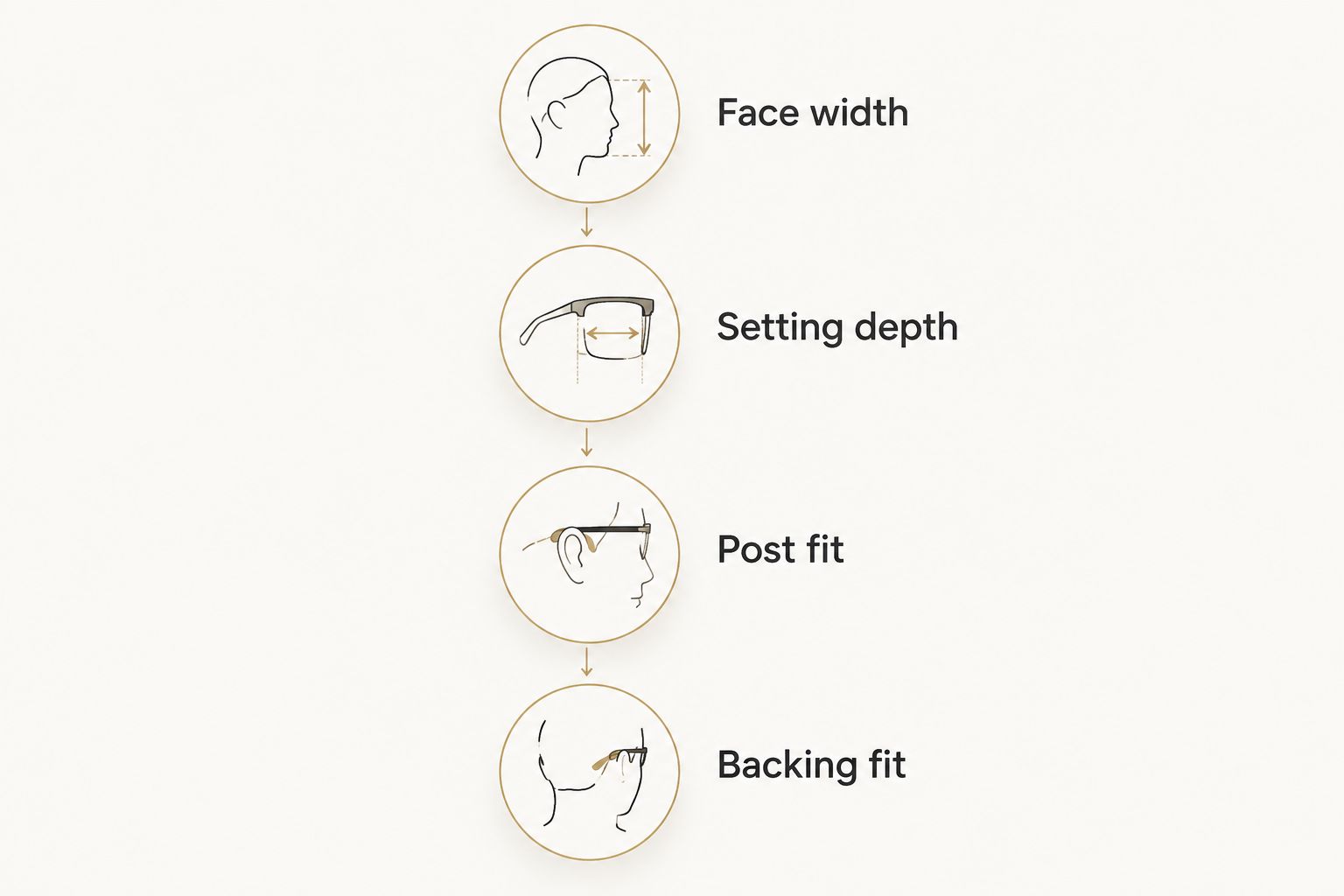
Try the pair during the activities that define your day, subject to the seller’s return conditions. Put on your usual glasses or headphones and move your hair away from the setting. Stop wearing earrings that cause pain or irritation; a different gemstone will not fix an unsuitable post or backing.
Care without guessing the construction
Cleaning advice needs to match the complete earring, including coatings, accent stones, and any treatments. Do not assume that instructions for loose moissanite apply unchanged to every finished setting.
- Follow the care instructions supplied for the specific pair.
- Avoid abrasive cleaning methods that can affect finishes.
- Check for movement, bent posts, or prongs that catch fabric.
- Stop wearing a pair with a loose stone until it has been assessed.
- Store earrings so they do not rub against other jewelry.
A quick inspection is more useful than treating a hard gemstone as an indestructible earring. Stones, settings, posts, and backs have different jobs—and different failure points.
How the designs rank
This 2026 ranking prioritizes a straightforward everyday appearance, followed by distinct shape preferences. Six-prong solitaire studs take the default slot; princess-cut solitaire, round halo, and cushion halo designs answer different visual preferences rather than competing for the same buyer.
The ranking does not score unverified weight, closures, metal construction, or long-term performance. Design narrows the shortlist. Verified specifications decide the purchase.
Which moissanite stud earrings should you choose?
Start with six-prong solitaire studs if you are undecided. Move to princess-cut solitaire studs for square geometry, round halo studs for a decorative circle, or cushion halo studs for a softer square outline.
Keep your 2026 decision simple: choose the outline, verify moissanite identity, confirm the metal construction, then check fit. Do not let a clarity label substitute for those steps.
FAQ
What are the best moissanite stud earrings for everyday wear?
A solitaire design is the default starting point for shoppers who want a single-stone everyday look. Choose six-prong solitaire studs by design preference, then verify moissanite identity, metal construction, dimensions, and backing fit.
Is moissanite the same as a lab-grown diamond?
No. Moissanite is silicon carbide, while a lab-grown diamond is carbon. Lab-created describes how a stone originated, not which gemstone it is.
Does VVS1 mean an earring contains moissanite?
No. VVS1 is a clarity designation, not a gemstone identity. Require a separate statement identifying the stone as moissanite.
Are solitaire studs better than halo studs for daily wear?
Solitaire studs are better for a simpler appearance; halo studs suit shoppers who want surrounding detail. Comfort depends on the actual dimensions, setting depth, posts, and backs rather than the design category alone.
Does 18k gold mean the entire earring is solid gold?
No. An 18k gold alloy contains 75% gold, but the wording alone does not establish the earring’s construction. Check whether the description identifies solid gold, plating, or another gold-layer construction.
What should I verify before buying studs from Lumina Jewelry Co.?
Verify the specific pair’s gemstone identity, metal construction, dimensions, posts, and backs. The brand’s general description of hand-finished jewelry with lab-created VVS1 stones does not replace those product-level details.
Can I sleep in moissanite stud earrings?
Remove studs for sleep if they press, catch, or cause discomfort. Gemstone identity does not establish that a particular post, backing, or setting is suitable for sleeping.
One last thing
Check the side view before buying. The front shows the design you want; the side helps you judge the projection you will wear. A beautiful outline does not compensate for a setting that conflicts with your daily routine.